
 Christopher Cummins · 5 min read
Diabetic Foot Care in Oxford MS: 6 Critical Daily Steps
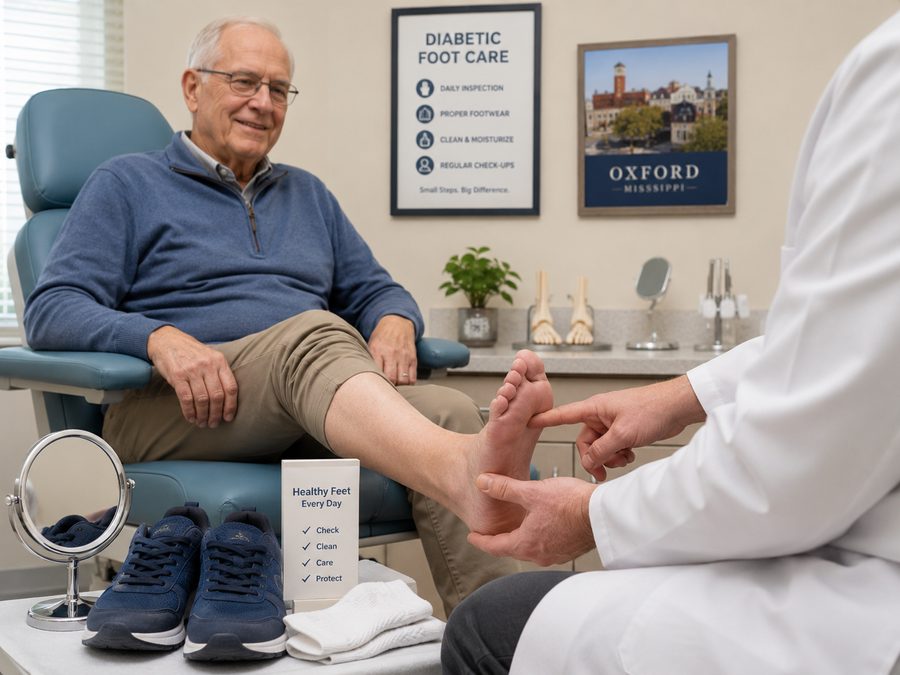
Diabetic foot care in Oxford MS comes down to a routine that takes about five minutes and prevents problems that can take months to resolve. That trade is as lopsided as it sounds, which is why the CDC states plainly that most people with diabetes can prevent serious foot complications through regular home care and keeping their appointments.
The reason the routine matters is mechanical rather than mysterious. About half of all people with diabetes have some kind of nerve damage, and the nerves in the feet and legs are most often affected. When sensation is reduced, the ordinary warning system fails. As the CDC puts it, you could walk on a stone in your shoe all day without knowing, or develop a blister and never feel it. The injury is not the problem. The not noticing is.
The Daily Routine
1. Look at Your Feet Every Day
Check for cuts, redness, swelling, sores, blisters, corns, calluses, or any change to the skin or nails. Do this even when your feet feel completely fine, because feeling fine is exactly what reduced sensation produces.
If you cannot easily see the bottoms of your feet, place a mirror on the floor and step over it, or ask someone to look for you. Skipping the underside defeats the purpose, since that is where pressure injuries tend to form.
2. Wash Daily, and Do Not Soak
Wash your feet every day in warm water, not hot, and dry them thoroughly. Temperature matters more than it seems: if sensation is reduced, water that feels comfortable may not be.
Soaking is discouraged because it dries the skin out, and dry skin cracks. Cracks are entry points for infection.
3. Moisturize, But Not Between the Toes
Use lotion on the tops and bottoms of your feet to keep the skin soft and prevent cracking. Leave the spaces between the toes dry, since trapped moisture there encourages fungal infection.
4. Never Go Barefoot, Even Indoors
This one gets ignored more than any other item on the list, and it is the one that produces the most preventable injuries. A tack, a splinter, a stubbed toe, or a dropped object can cause damage that goes unnoticed for days when sensation is reduced.
Shoes or slippers indoors, socks always. Before putting shoes on, check inside them for small rocks or debris, because a foreign object you cannot feel will keep working against the same spot for hours.
5. Wear Shoes That Actually Fit
Buy shoes that fit comfortably at the moment of purchase. Never buy tight shoes hoping they will stretch, because reduced sensation means you may not feel the rubbing that leads to a blister and then to a sore.
Clean, dry socks made of material that pulls moisture away from the skin do more work than most people credit them for.
6. Trim Nails Carefully, and Leave the Rest to a Professional
Trim toenails straight across and gently smooth sharp edges with a nail file. If you cannot see or reach your feet, or if your nails are thick and discolored, have a professional do it.
Here is the item that matters most on the entire list, because it is the one where good intentions cause the most harm: do not remove corns or calluses yourself. Do not cut them, and do not use over-the-counter removal products, which can burn the skin. The American Diabetes Association is direct about the consequence, noting that untrimmed calluses can thicken, break down, and turn into open sores, and that cutting them yourself can lead to ulcers and infection. This is a task for a member of your care team.
Why Diabetic Foot Care in Oxford MS Deserves Daily
Attention
Mississippi carries a heavier diabetes burden than most of the country. The Mississippi State Department of Health reports that roughly one in seven Mississippians is living with diabetes, placing the state among the top five nationally, and it specifically names loss of protective sensation and lower extremity amputation among the complications.
That regional context is not meant to alarm anyone. It is meant to explain why a five-minute habit is worth building here in particular, and why "my feet feel fine" is not the reassurance it sounds like.
What Should Prompt a Call
Some findings should not wait for your next scheduled appointment:
A sore, blister, cut, or ulcer that is not healing.
Redness, warmth, swelling, or drainage, which can indicate infection.
A change in the color or temperature of the foot.
New numbness, tingling, or burning, or a loss of the ability to sense heat and cold.
Any change in the shape of the foot or toes.
Thick, yellow, or discolored toenails.
An ingrown toenail or an infected corn.
The general rule is that anything on a foot with reduced sensation deserves attention sooner than the same finding would on a foot with normal sensation, because your usual signal that something is getting worse is not reliable.
Getting Your Feet Checked as Part of Regular Care
The CDC recommends having your feet checked at every visit with your primary care provider, and a complete foot exam annually, more often if you have nerve damage. A complete exam includes checking sensation and blood flow.
CMC MD PLLC provides primary care services covering comprehensive evaluations for everyday medical needs, which is the appropriate setting for a foot check to happen routinely rather than only when something has gone wrong. For patients whose nerve symptoms are already present, the clinic offers Neuropathy and Nerve Spa Therapy, a non-invasive approach aimed at improving nerve function, stimulating circulation, and reducing inflammation, with sessions typically running 20 to 30 minutes.
The clinic is candid that full reversal of neuropathy is not guaranteed, though symptoms can improve significantly with proper therapy. Daily foot care remains important regardless of what treatment you are receiving. The two are not alternatives to each other.
Care From a Physician With Nearly Three Decades of Experience
Dr. Christopher Marascalco Cummins is a third-generation physician, family medicine trained,
with more than 27 years of experience and over 22 years of service as a U.S. Army veteran. His practice emphasizes practical, evidence-based solutions that reduce pain, restore function, and help patients get back to daily life, with a stated approach of treating the person rather than just the problem.
For diabetes-related foot risk, that means looking at blood sugar, circulation, and nerve function together rather than treating a sore as an isolated event.
Take Your Shoes Off at Your Next Visit
Foot exams get skipped for an unremarkable reason: nobody brings it up, and shoes stay on. If it has been a year or more since anyone checked the sensation and blood flow in your feet, ask at your next appointment.
CMC MD PLLC is located at 501 Heritage Drive, Suite 111, Oxford, MS 38655, and is open Monday through Friday from 9:00 a.m. to 4:00 p.m. Call (978) 444-2273 or book an appointment online.